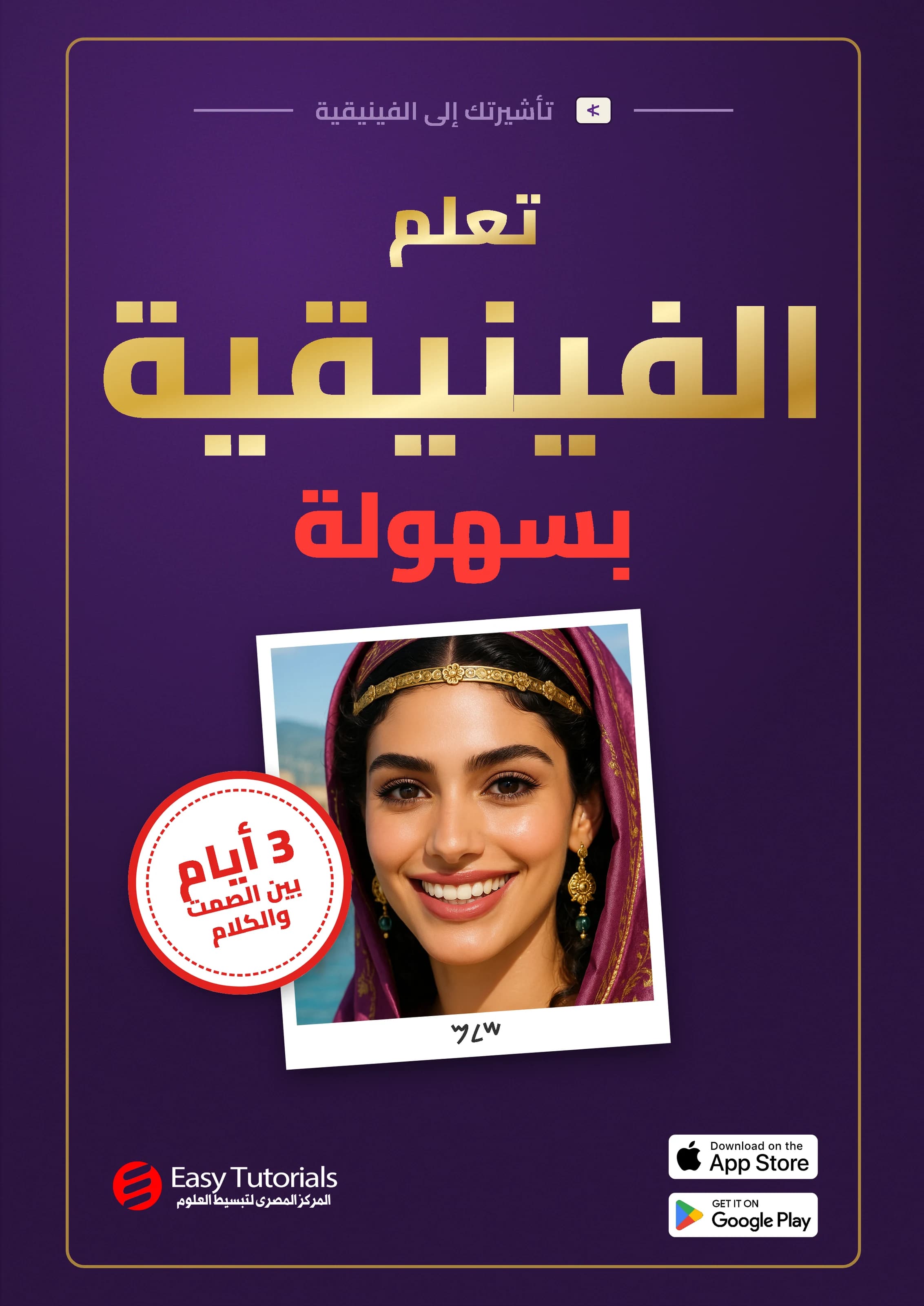
Learn Phoenician Easily
A straightforward guide to mastering the Phoenician language
Unlock the secrets of one of history's most fascinating languages.
What you'll learn
- Basic Phoenician vocabulary
- Fundamental grammar rules
- Reading and writing Phoenician script
- Understanding historical context
- Practical exercises for skill reinforcement
- Cultural insights into Phoenician civilization
About this book
Learn Phoenician Easily is designed for anyone interested in exploring the rich linguistic heritage of the Phoenician civilization. This book provides a clear and accessible approach to understanding the Phoenician language, making it suitable for beginners and enthusiasts alike.
With carefully structured lessons and practical exercises, readers will gain confidence in reading and writing Phoenician. The book not only covers the basics of the language but also delves into its historical context, allowing learners to appreciate its significance in the development of modern alphabets.
Who this book is for
- Language learners
- History enthusiasts
- Students of ancient cultures
- Linguists and philologists
- Travelers interested in Phoenician heritage
Why read this book
- User-friendly structure for easy learning
- Engaging exercises to reinforce knowledge
- Historical insights that enrich the learning experience
- Suitable for all ages and backgrounds
About the language
Phoenician is a dead Semitic language, from the same family as Arabic. It was the language of the cities on the eastern Mediterranean coast such as Tyre, Sidon and Byblos. Phoenician traders spread it across the Mediterranean as far as Carthage in Tunisia, where it was known as Punic.
Where it is spoken

Lebanon, Syria, Tunisia, Cyprus, Malta
Writing system
Written in the Phoenician alphabet of 22 letters, all consonants, from right to left.
Quick facts
- The Phoenician alphabet is the ancestor of the Greek and Latin alphabets, and of the Aramaic alphabet from which Arabic script came.
- The name Carthage means new city in Phoenician.
- Punic was still spoken in North Africa until about the 5th century AD.
- Letters were named after things: aleph meant ox and bet meant house.
Why learn it
- Read Phoenician inscriptions in Lebanon, Syria and Tunisia yourself.
- Study archaeology and the history of Mediterranean trade and seafaring.
- Understand the story of the alphabet behind most of the world's scripts, including Arabic.
Words shared with Arabic
- bt — Semitic cognate of Arabic bayt, meaning house.
- mlk — Cognate of Arabic malik, meaning king.
- shmsh — Cognate of Arabic shams, meaning sun.
- qrt — Cognate of Arabic qarya, meaning city; it gives the name Carthage.
Comes with the book: the «Learn and Speak Easily» app
The book teaches you the word; the app trains you to say it. Open the app with your easyT account and practise every word and phrase in the book out loud.
1,422 words and phrases to practise in this book
Hear the right pronunciation
Every word and phrase in the book, spoken clearly, at normal speed or slowly.
Test yourself on every sign
The app shows a sign and asks for its meaning or its sound; pick the right answer out of 4.
The book's own chapters
Same chapters in the same order, with the word, its pronunciation in Arabic letters, its meaning and the book page.
A quiz after every chapter
Quick questions on what you learned; the app keeps your best score and your progress per chapter.
App details
- Free for everyone who bought the book, printed or digital
- Every language is open to Premium subscribers
- Sign in with your easyT account
- Works offline after a language is opened once
- Checking runs on your phone — your voice is never recorded or stored

 Coming soon to the store