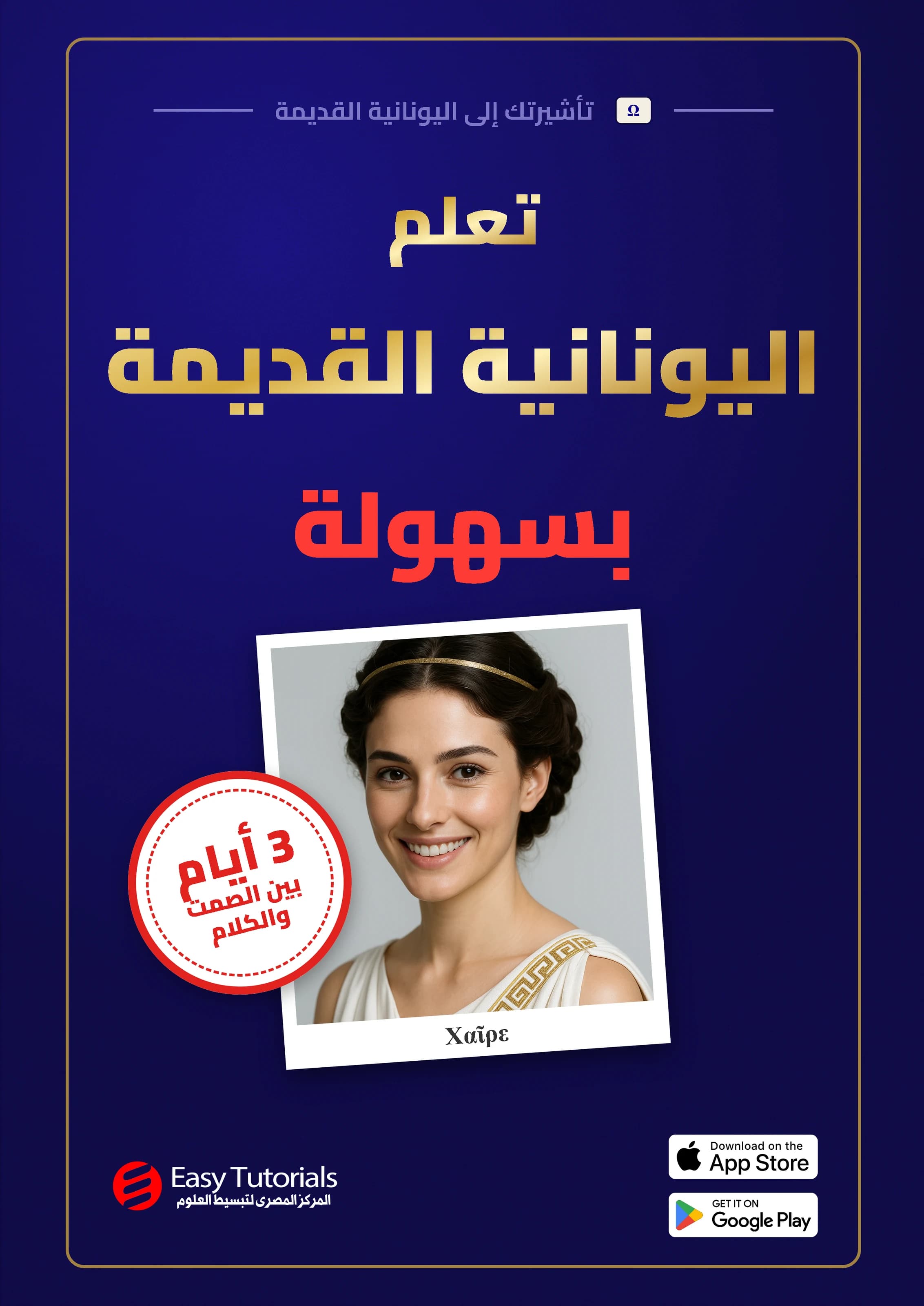
Learn Ancient Greek Easily
A straightforward guide to mastering the language
Unlock the secrets of Ancient Greek with ease and confidence.
What you'll learn
- Basic vocabulary and grammar
- Reading comprehension of texts
- Writing simple sentences
- Understanding sentence structure
- Translating short passages
- Cultural context of Ancient Greece
About this book
This book serves as an accessible introduction to Ancient Greek, designed for learners of all levels. With clear explanations and practical exercises, it demystifies the complexities of the language, making it approachable for anyone interested in classical studies.
Whether you're a student, a scholar, or simply a language enthusiast, this guide equips you with the foundational skills needed to read and understand Ancient Greek texts. Its structured approach ensures that you build your knowledge progressively, paving the way for deeper exploration of Greek literature and philosophy.
Who this book is for
- Students of classical languages
- History enthusiasts
- Literature scholars
- Linguistic hobbyists
- Educators seeking resources
Why read this book
- User-friendly layout for easy navigation
- Practical exercises to reinforce learning
- Cultural insights to enhance understanding
- Step-by-step progression from basics to advanced concepts
About the language
Ancient Greek is a classical Indo-European language, the language of Homer, Plato and Aristotle. It no longer has native speakers, but it is the ancestor of Modern Greek and is still taught in schools and universities.
Where it is spoken

Greece, Cyprus
Writing system
Written in the Greek alphabet, from left to right.
Quick facts
- The Greek alphabet was adapted from the Phoenician alphabet, with vowel letters added by the Greeks.
- Alexandria was a major center of Greek learning, home to its famous library, where Euclid worked.
- Scholars at the House of Wisdom in Baghdad translated Aristotle, Galen and Ptolemy from Greek into Arabic.
- Many modern scientific terms are built from Ancient Greek words.
Why learn it
- Study: read Greek philosophy, medicine and mathematics in the original language.
- Science: understand the origins of modern scientific and medical terms.
- Culture: understand the Baghdad translation movement and the impact of Greek thought on Arab civilization.
Words shared with Arabic
- κανών (kanon) — Meaning rule, the source of Arabic qanun, law.
- κλίμα (klima) — Meaning a zone of the earth, the source of Arabic iqlim, region.
- φιλοσοφία (philosophia) — Meaning love of wisdom, the source of Arabic falsafa.
- κεράτιον (keration) — Meaning carob seed, the source of Arabic qirat, carat.
- δραχμή (drachme) — A Greek coin, the source of Arabic dirham.
Comes with the book: the «Learn and Speak Easily» app
The book teaches you the word; the app trains you to say it. Open the app with your easyT account and practise every word and phrase in the book out loud.
1,854 words and phrases to practise in this book
Hear the right pronunciation
Every word and phrase in the book, spoken clearly, at normal speed or slowly.
Test yourself on every sign
The app shows a sign and asks for its meaning or its sound; pick the right answer out of 4.
The book's own chapters
Same chapters in the same order, with the word, its pronunciation in Arabic letters, its meaning and the book page.
A quiz after every chapter
Quick questions on what you learned; the app keeps your best score and your progress per chapter.
App details
- Free for everyone who bought the book, printed or digital
- Every language is open to Premium subscribers
- Sign in with your easyT account
- Works offline after a language is opened once
- Checking runs on your phone — your voice is never recorded or stored

 Coming soon to the store