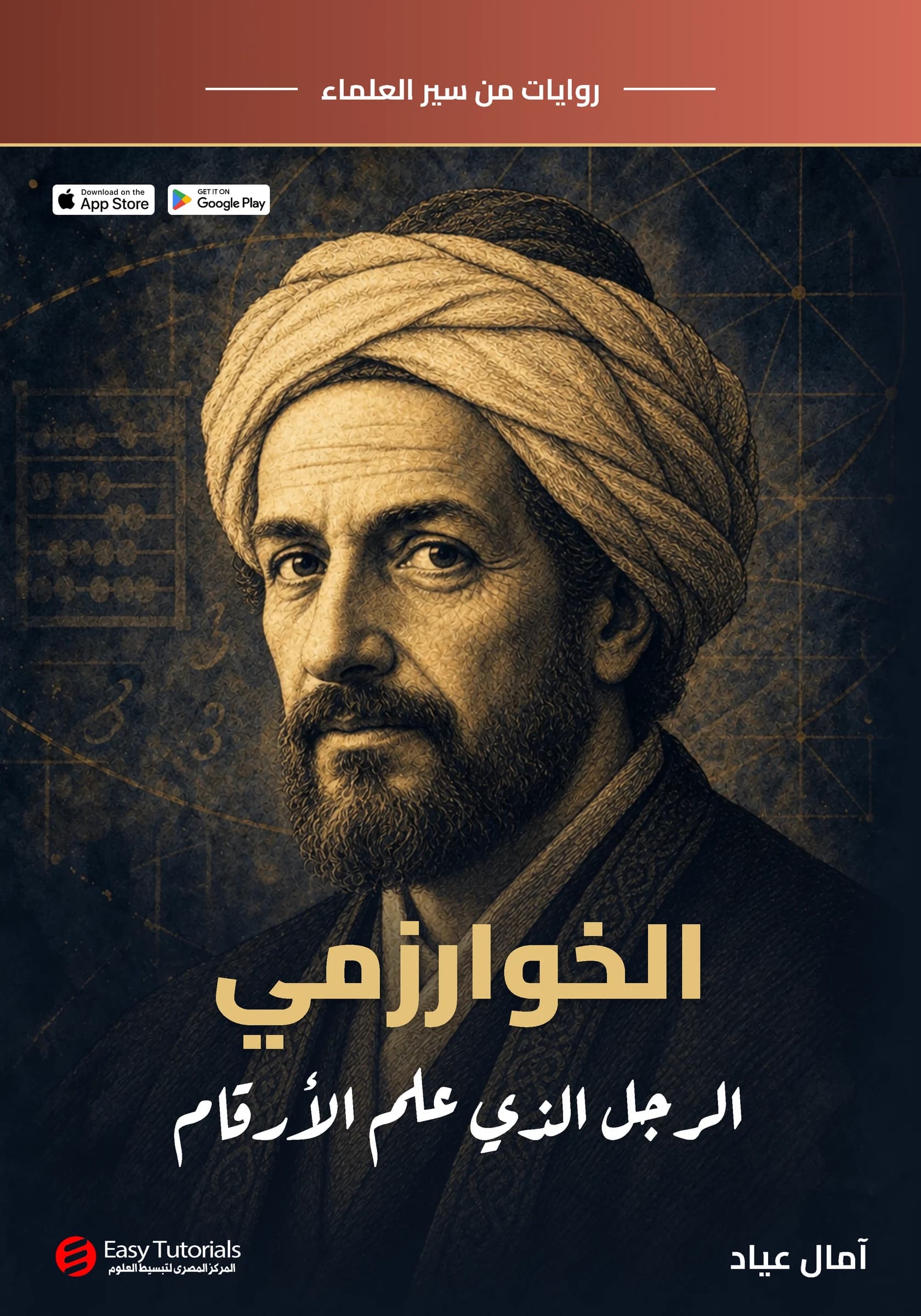
Al-Khwarizmi: The Man Who Taught Numbers
A novel from the series "Novels from the Lives of Scientists"
Al-Khwarizmi's life as you have never read it: a true story told scene by scene.
What you'll learn
- Follow Al-Khwarizmi's life from his childhood in Khwarazm to his last days in Baghdad as one connected story
- Understand why a small circle keeps the place of an empty column, and how the Indian numerals can write any number
- See how algebra grew out of people's everyday problems and the picture of a balance scale
- Learn how scholars measured the Earth with ropes and the North Star, and how cities were placed on a map
- Meet the friends and pupils who live with him in the story
- Tell what really happened from what the author imagined in every chapter
About this book
Baghdad, around 820. A man of about 40 sits in the House of Wisdom, a great house of books, in front of a pile of people's problems: a merchant splitting a profit, a farmer measuring a field, a canal digger working out his workers' pay. The door bursts open and Hassan the builder walks in holding a broken brick. His wall has stopped halfway, because a note that said 205 bricks was read by the brickmaker as 25. The old scribe says these new numbers are a children's game. The man says the fault is not in the numbers, but in the small circle that was never written.
This is a novel, not a biography. It starts with a boy in Khwarazm, on a great river called the Oxus, counting pebbles on the board of the merchant Rustam. It follows him with a caravan to the round city of Baghdad, then into the House of Wisdom among the books and the numbers that came from India, then through his tables of the stars, with Ziyad, the orphan boy who grinds the ink, then onto the plain of Sinjar where ropes are stretched to measure the Earth, until, centuries later, his name reaches every computer in the world. The main events, dates and names are real, and the story is told in scenes and dialogue as if you were watching it.
The science is explained with pictures from daily life: zero is a house where nobody lives, yet it keeps its place on the street; two pans of a scale stay level when you take the same from each; a bag short of a handful gets its handful back, the way a bonesetter puts a bone back in place; a square field missing a corner is completed with small pieces; the North Star climbs higher as you walk north. No equations and no difficult terms. A final section tells you clearly what is real and what is imagined in every chapter.
The book is written in Arabic.
Who this book is for
- Young readers aged 13 to 18
- Lovers of novels and life stories
- Parents looking for useful reading for their children
- Teachers
- Anyone who loves science but not equations
Why read this book
- 14 chapters in 240 pages
- Real events, dates and names
- Simple, gripping Arabic
- A line drawing at the start of every chapter