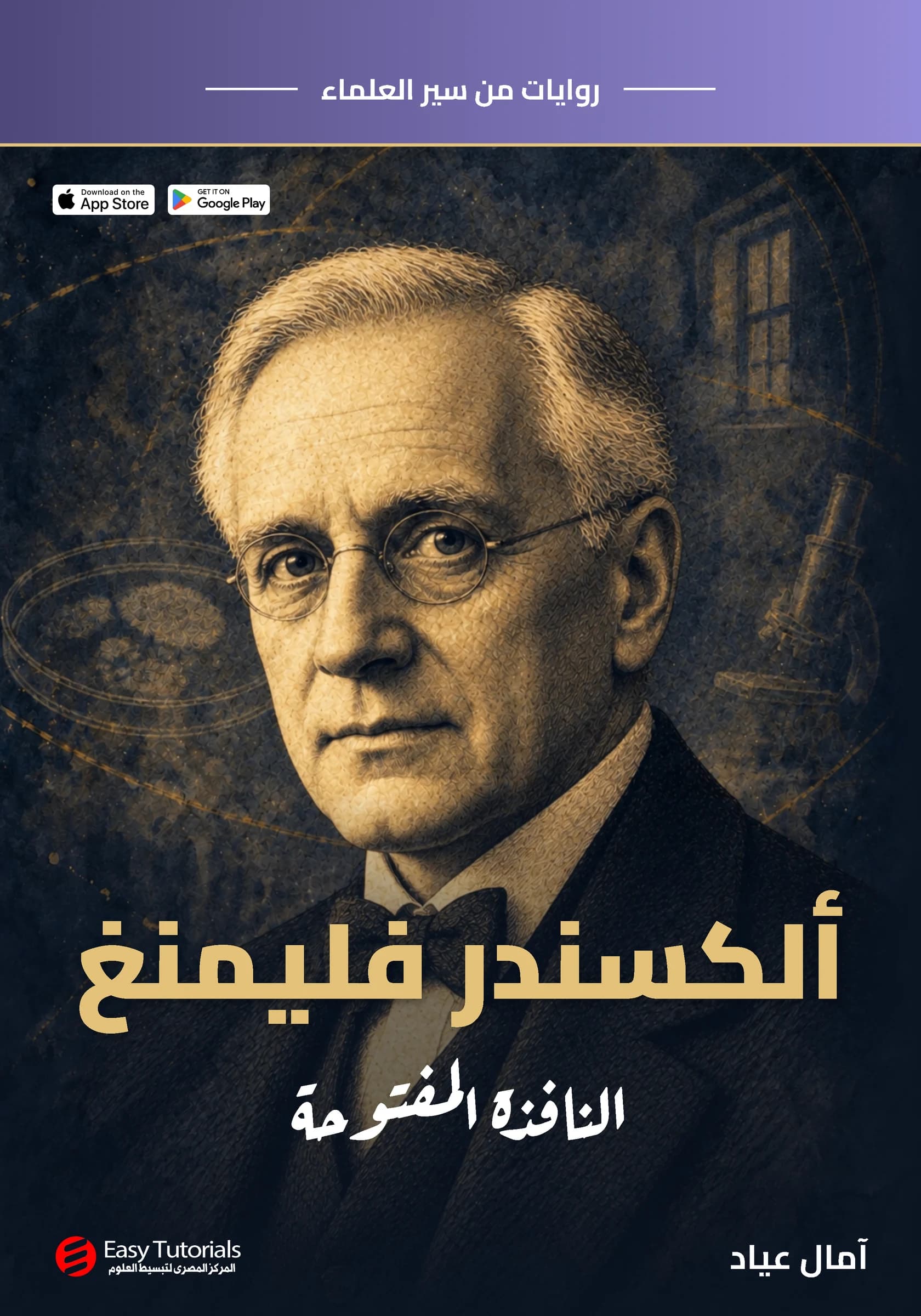
Alexander Fleming: The Open Window
A novel from the series "Novels from the Lives of Scientists"
Fleming's life as you have never read it: a true story told scene by scene.
What you'll learn
- Follow Fleming's life from his childhood in the hills of Scotland to his last days in London as one connected story
- Understand why he did not throw away the dish with the mould, and how a scientist looks at what others throw away without a second look
- See how he found a substance in tears that dissolves some germs, and why it was not enough
- Learn how the mould juice became a medicine in Oxford, and why germs learn not to fear the medicine
- Meet the friends and colleagues who live with him in the story
- Tell what really happened from what the author imagined in every chapter
About this book
London, 3 September 1928. A short man of 47, with a bow tie at his neck, comes back from his summer holiday to his tiny room in the hospital at Paddington. His table is as messy as he left it, and the sink is full of dishes. He lifts them one by one, while his old assistant Pryce laughs: you will spend the whole week washing up. Then he falls silent. In one dish there is a green spot of mould, with a clear circle around it, and the germs near it are melting away. He says: that's odd. A colleague passing with a cup of tea says: mould, throw it out and grow another. But he picks up a little of the mould with a needle and puts it in a tube on the shelf.
This is a novel, not a biography. It starts with a boy on Lochfield farm in the hills of Scotland, who walks 4 miles to school every day and 4 miles back. It follows him as a clerk in a shipping office in London, then as a medical student who stays in the department because of the shooting team, then as a man who paints houses and people with coloured germs, then in a hospital for the wounded by the sea in Boulogne, then with tears and lemon peel, then with the mould juice he named penicillin, until the men of Oxford turn it into a medicine, a man who had lost consciousness wakes up, and Fleming receives the Nobel Prize in 1945. The main events, dates and names are real, and the story is told in scenes and dialogue as if you were watching it.
The science is explained with pictures from daily life: germs in a wound are like weed seeds fallen into a field; the mould is like an orchard with a stone wall the sheep never cross; a deep wound is like a rabbit hole with a narrow door and tunnels inside where the antiseptic cannot reach; the juice diluted again and again is like a drop of ink in a bucket of water; germs that get too little medicine are like crows that learn the scarecrow never moves. No equations and no difficult terms. A final section tells you clearly what is real and what is imagined in every chapter.
The book is written in Arabic.
Who this book is for
- Young readers aged 13 to 18
- Lovers of novels and life stories
- Parents looking for useful reading for their children
- Teachers
- Anyone who loves science but not equations
Why read this book
- 14 chapters in 240 pages
- Real events, dates and names
- Simple, gripping Arabic
- A line drawing at the start of every chapter