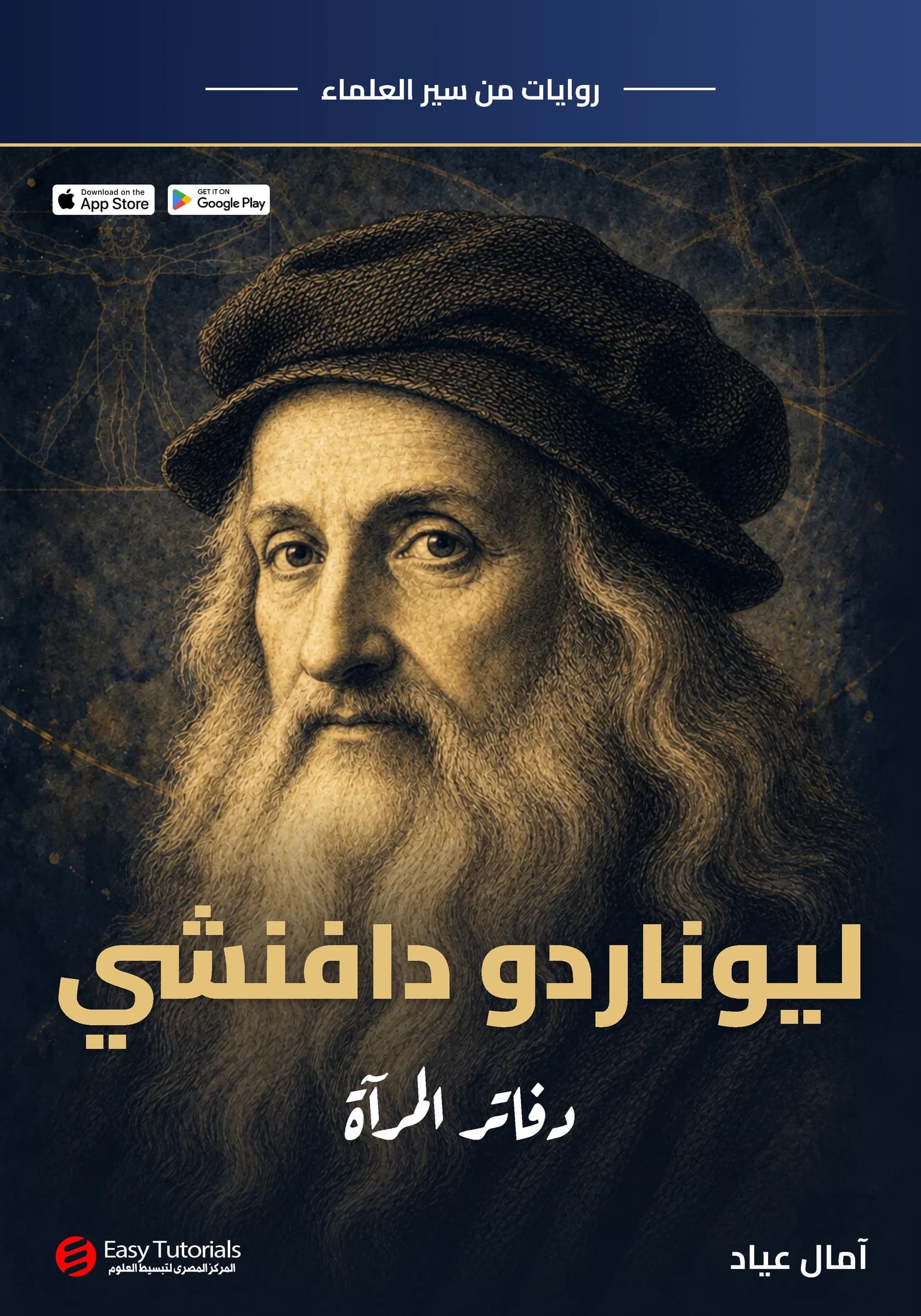
Leonardo da Vinci: The Mirror Notebooks
A novel from the series "Novels from the Lives of Scientists"
Leonardo da Vinci's life as you have never read it: a true story told scene by scene.
What you'll learn
- Follow Leonardo da Vinci's life from his childhood in Vinci to his last days as one connected story
- Understand how he studied the flight of birds and the swirling of water through everyday examples
- See how a big question grows out of long looking and writing everything down in a notebook
- Learn how he kept going when the greatest work of his life was broken
- Meet the master, pupils and friends who lived with him and shaped him
- Tell what really happened from what the author imagined in every chapter
About this book
Milan, autumn 1499. A man of 47 stands in the courtyard of a great palace. In front of him is a clay horse more than 7 metres tall, which he shaped with his own hands over years so he could cast it in bronze. Strangers are shooting arrows at it, the clay is falling away, and he cannot stop them. He goes home, packs his notebooks into the chest before his clothes, and leaves.
This is a novel, not a biography. It starts with a boy in Vinci who remembers a bird that came down to his cradle and brushed his lips with its tail. It follows him as a boy in the workshop of his master Verrocchio in Florence, then drawing the valley from the top of a hill, then in Milan with the great horse and Salai the mischievous boy, then through his years of travel all the way to Amboise. Everywhere, a small notebook hangs from his belt, and he writes down everything he sees. The events, dates and names are real, and the story is told in scenes and dialogue as if you were watching it.
The science is explained with pictures from daily life: a page written backwards that turns readable when held up to a mirror, a far mountain that looks blue because the air between us is like a thin curtain, water curling around a stone like locks of hair, a glass heart filled with water and grass seeds that swirl. No equations and no difficult terms. A final section tells you clearly what is real and what is imagined in every chapter.
The book is written in Arabic.
Who this book is for
- Young readers aged 13 to 18
- Lovers of novels and life stories
- Parents looking for useful reading for their children
- Teachers
- Anyone who loves science but not equations
Why read this book
- 14 chapters in 240 pages
- Real events, dates and names
- Simple, gripping Arabic
- A line drawing at the start of every chapter