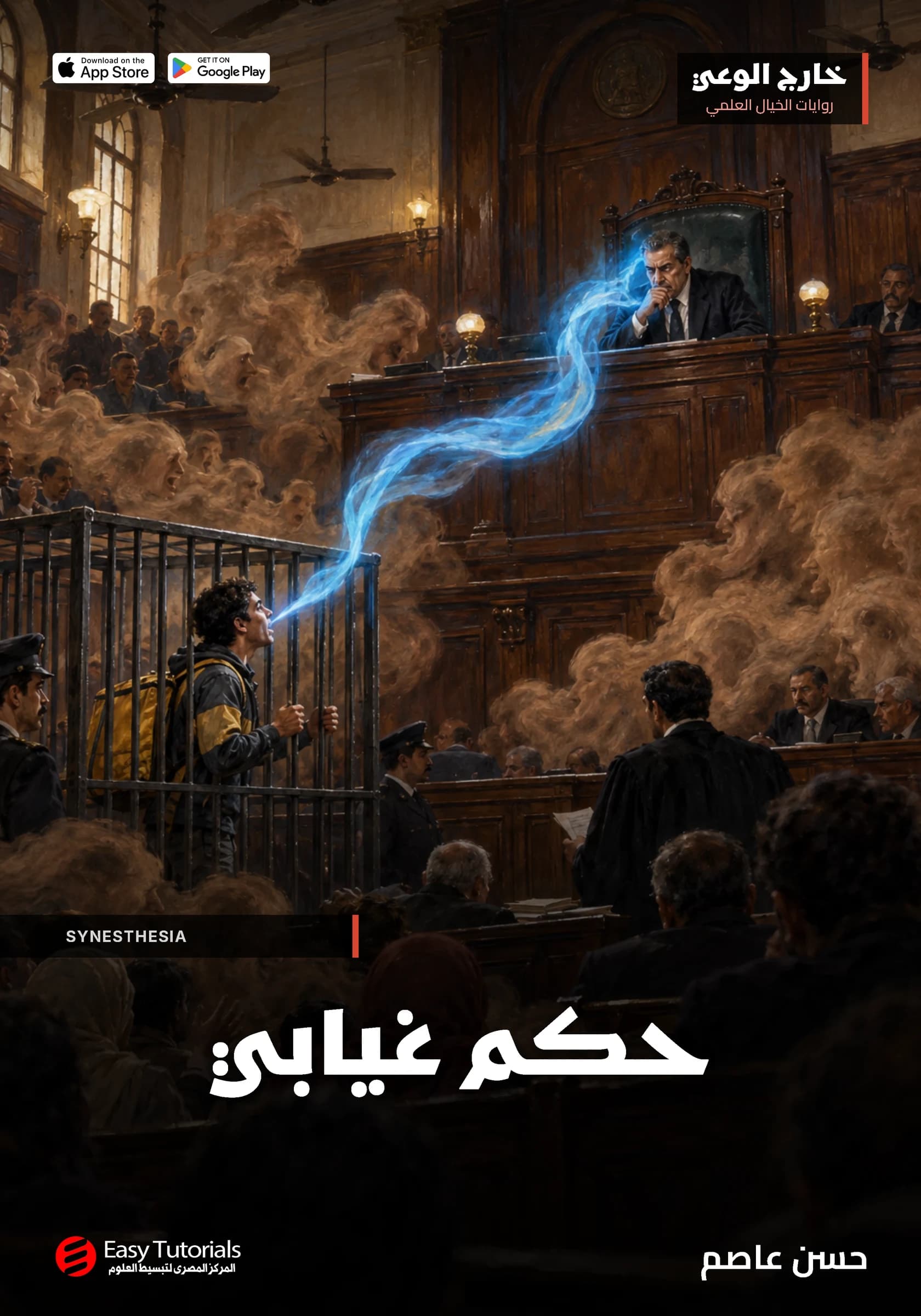
Judgment in Absentia
A novel from the series "Beyond Awareness"
A judge who sees lies as the color of mud, and a defendant with all the evidence against him and a perfectly clear voice.
What you'll learn
- Understand what synesthesia is, and why some people see sounds and numbers as colors
- Learn how scientists tell the real condition from pretending with a simple, clever test
- Discover why neither machines nor people can detect lies with certainty
- Understand how an honest witness can be wrong, and why memory rebuilds what it saw
- Live the story of a judge torn between the papers and what only he can see, between his post and his home
- Tell the real science from the novel's fiction in a special section at the end
About this book
The misdemeanor court of Abdeen in Cairo, a morning in early October 2025. Judge Adel El-Tokhy walks from his home in Garden City, and the whole street is color: the bean seller's voice is dark red, car horns are sharp yellow lines, and a child sings in light blue. In the courtroom there are 47 cases, and Uncle Ramzy calls the names in his flat green voice. A witness says he saw everything with his own eyes, his voice clouds over with the color of mud, the judge closes his eyes, and he rules on the papers, as he has for 20 years. At the end of the session a thin young man stands up, a scratched yellow helmet in his hands, sentenced in absentia to one year in prison. The judge asks: what do you say to the charge? He lifts his head and says: I did not hit him. And Adel opens his eyes, because the voice is clear blue, like water in a clean glass.
Adel has seen sounds as colors since childhood, and he sees the voice of anyone who knowingly lies cloud over with mud. But he has made himself a rule to judge only by the papers, because what he sees is not evidence, and no one would believe him. And here every paper is against Rami Fattouh, a delivery rider: the motorbike's number was read by Moallem Abdo, the café owner; the bike is in Rami's name and was found in Reda's workshop with a broken headlight; and the victim is an old shoemaker, Sobhy El-Gammal, on a street Adel has known since he was a boy. The victim's daughter Hoda wants the truth, and the prosecutor Basel believes every word he says. At home there is his wife Mona, her small sketchbook, and small kind lies she does not know he can see. His old teacher Helmy warns him: a judge who rules by what is in his own head alone can become unjust. Will Adel break his rule? And what will it cost him if he does?
Seeing sounds as colors is a real condition called synesthesia: one sense switches on another. Scientists have found that about 4 in every 100 people have some form of it, and that it is not an illness. A simple picture: two wires side by side in an old building, so when the doorbell rings, the stairway lamp lights up. A clever test reveals the real condition: the person gives the same sound the same color weeks later, without remembering or memorizing. As for lie detection, no machine and no person can do it well even today; people get it right about half the time, like tossing a coin. At the end of the novel, a section called "What is real and what is imagined" separates the real science from the fiction.
The book is written in Arabic.
Who this book is for
- Fans of science fiction
- Fans of suspense and courtroom novels
- Anyone who likes to understand science without equations
- Readers curious about the human mind, senses and memory
- Lovers of Arabic fiction and anyone looking for a gripping read
Why read this book
- 14 chapters in 240 pages
- A real scientific phenomenon at the heart of the story
- Simple, gripping Arabic
- Suspense to the last page