A Living Corpse
A novel from the series "Beyond Awareness"
A man hears his family decide he is gone, and cannot tell them: I am here.
What you'll learn
- Understand what it means for the mind to be awake while the body cannot move
- Learn the difference between a coma and other states of awareness, and why judging by the eye alone can be wrong
- See how a patient can say yes and no with imagination alone: driving for yes, walking through a house for no
- Find out why each question is asked 5 times, and why fatigue and fever can silence the answer on the screen
- Live the story of Emad and his family, and a hard question about the price of truth
- Tell the real science from what the author imagined
About this book
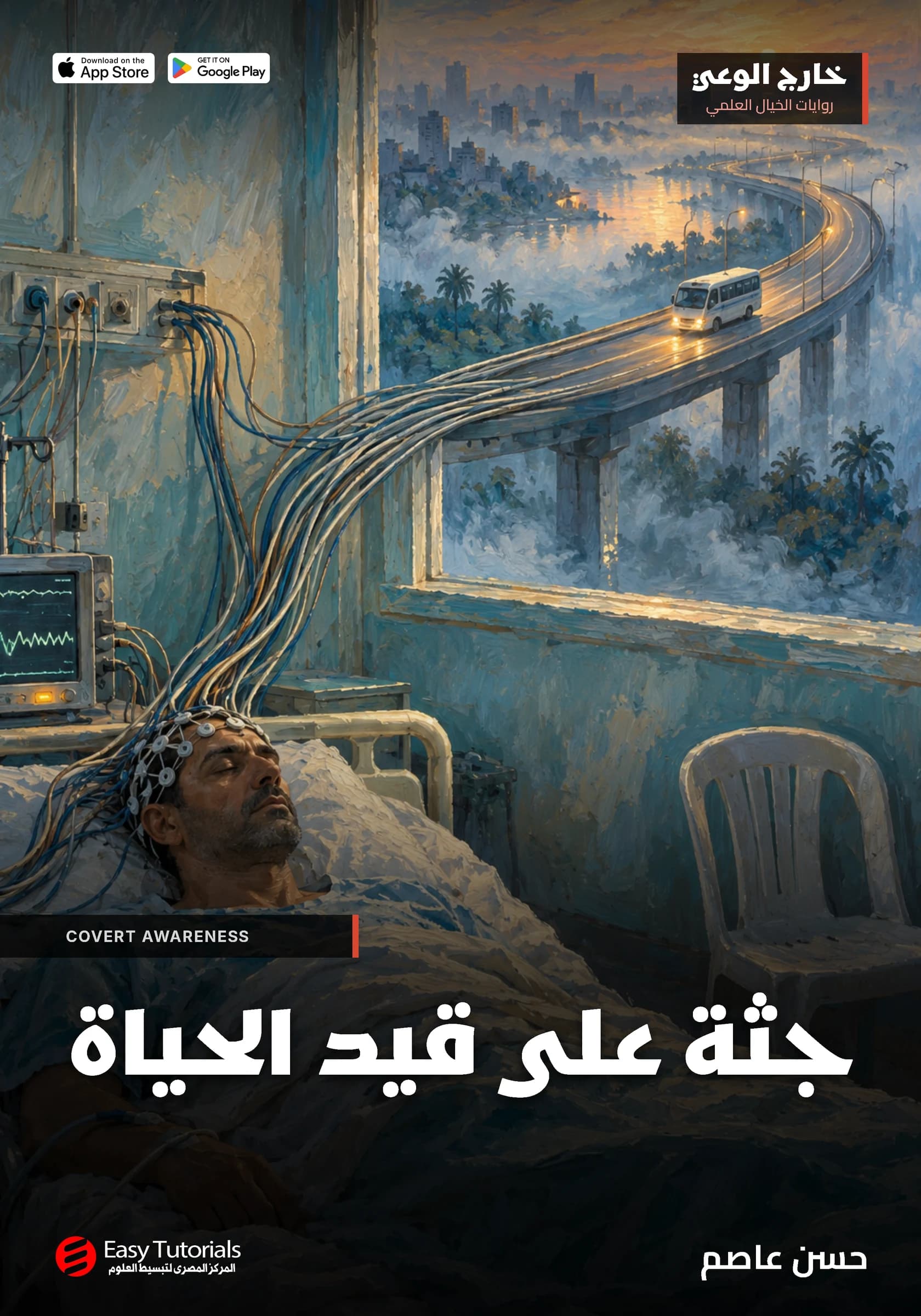
The intensive care unit of Umm al-Misriyyin General Hospital in Giza, April 2026. Emad El-Sayed Qandil, a 41-year-old microbus driver, has been lying in bed number 6 since a crash on the Ring Road at three in the morning. A machine breathes for him 14 times a minute, and he counts every breath, the way he counted the stops for his passengers for 15 years. His eyes are closed and nothing in him moves. But ears have no eyelids. He hears Insaf, the night nurse, reading out the sports page. He hears his mother Saneya wiping his face, and his brother Atef saying the ICU bed costs too much and the doctors say to take him home. Then he hears his wife Nagwa say: it would be better for him to go.
Emad wants one thing: to say "I am here" before they take him out of intensive care. His son Iyad, 12, comes after school and plays their old game of Twenty Questions with him, and no one answers. A strange girl named Basant gets into the ward with a lie and says one sentence at his bedside: my father is locked up because of you. Then comes Dr. Rehab El-Gendy, a neurologist who speaks to her patients by name. She tries a test without a single word: imagining driving the microbus on the Ring Road means yes, imagining walking through his mother's house means no. Emad finds a voice. But every answer drains him as if he had driven a whole day. His family and their lawyer are waiting for one answer about the night of the crash, and the first truth he tells cannot be taken back. Time is running out, and the hospital discharge form is waiting for a signature.
The science behind the story is real. In 2006 the British scientist Adrian Owen asked a woman who could not move to imagine playing tennis, and the same part of her brain worked as in a healthy person imagining the same thing. The picture is simple: a footballer closes his eyes before a penalty kick, his legs still and his head playing. Later, patients answered yes and no this way, then with a simple brain-wave cap at the bedside. The machine does not read thoughts; it only sees which part of the brain is working, like seeing lit windows from the street and knowing someone is home. In 2024 a large study found that about 1 in 4 patients who could not move were hearing and understanding. No equations and no difficult terms. A final section called "What is real and what is imagined" separates the real science from the fiction.
The book is written in Arabic.
Who this book is for
- Fans of science fiction
- Fans of suspense and thriller novels
- Anyone who likes to understand science without equations
- Readers curious about the secrets of the mind and the brain
- Anyone looking for a gripping Arabic novel they cannot put down
Why read this book
- 14 chapters in 240 pages
- Built on a real scientific phenomenon: covert awareness
- Simple, gripping Arabic
- Suspense to the last page