A Second-Hand Life
A novel from the series "Beyond Awareness"
A 7-year-old boy wakes every night at 3 and says he is a man who died 30 years ago.
What you'll learn
- Discover what scientists have collected about children who say they remember a life before this one, and what the doubters say
- Understand why we forget our earliest years, and why first memories fade around the ages of 7 and 8
- See how the brain remembers "where" differently from names and words
- Learn why smell is the shortest road to memory
- Live the story of a mother racing against forgetting, between a village in Fayoum and an old printing press in Cairo
- Tell the real science from what the novel imagines
About this book
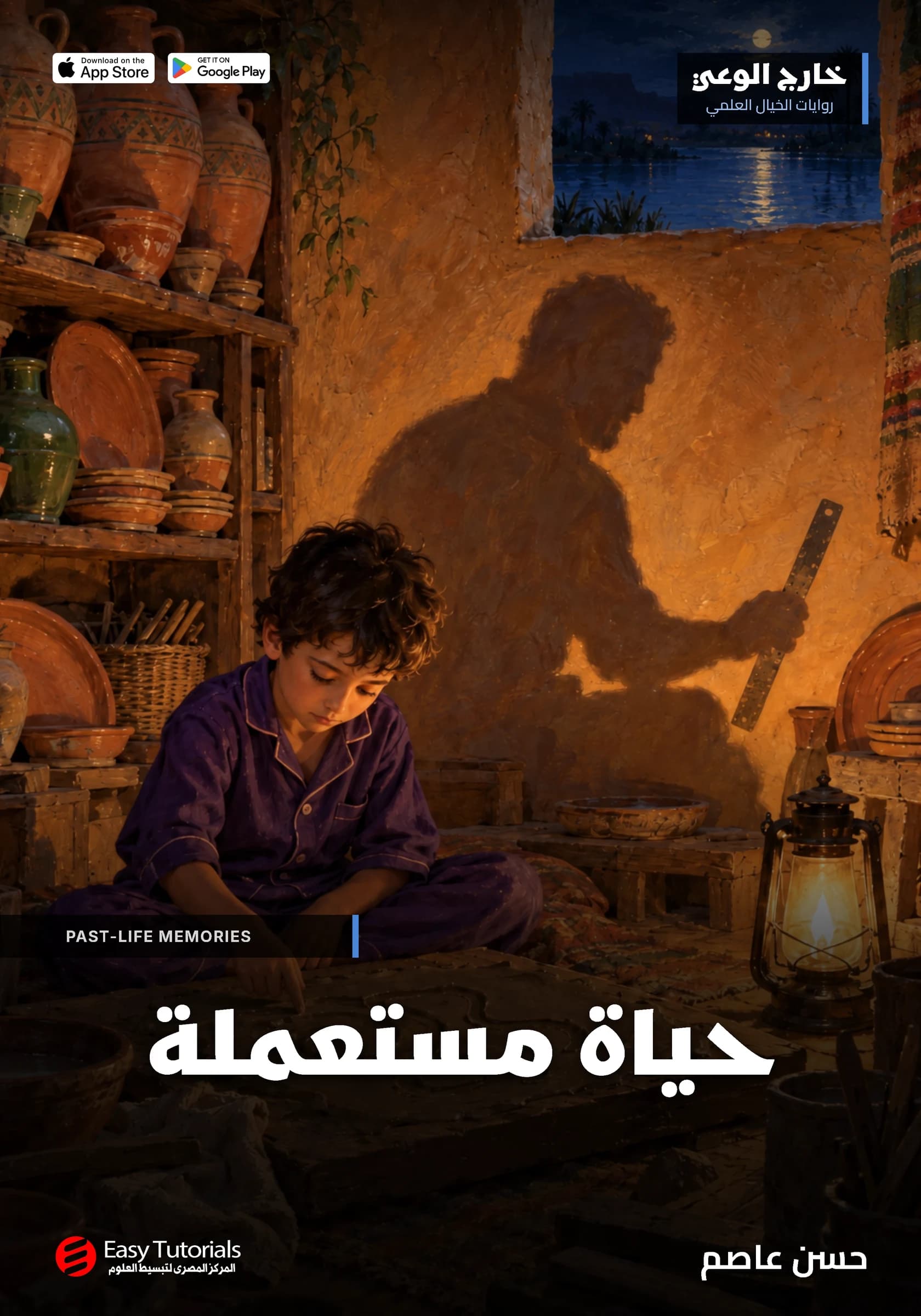
The village of Tunis in Fayoum, Egypt, on a night in October 2025. Hanaa wakes to the sound of her son Badr gasping. It is a few minutes past 3, like every time. The boy is sitting up in bed, his hand pressed to his chest, his eyes on a spot above the door. In a voice rougher than his own he says: open the window, Farag will find me in the morning. There is no one in the village called Farag. In the morning Badr draws a big, fat, mirror-reversed letter on a slab of soft clay and says: I don't know its name, he knows. In the evening he sniffs a wet newspaper and says its ink has been mixed with kerosene. Then he looks at his mother as if he does not know her and says: I am Mounir, and I own a printing press in Faggala.
Badr is 7 years old. His mother Hanaa is a potter who understands clay with her hands, and his father Shaaban sells pottery and fears what people will say. The doctor says the boy's heart is healthy. The child psychiatrist Nahla El-Hennawy writes down every word he says and tells Hanaa honestly that science does not know. Hanaa takes the bus to Cairo with her son, and Badr walks from the Ahmed Helmy bus station to an alley in Faggala like a man who knows the way. There stands an old printing press about to close, its letters about to be sold as lead by the kilo, and an old left-handed worker called Farag who thinks it is all a trick. In the story there is a lost right, a hidden paper, and time running out. But every day Badr remembers another man's life, he loses a piece of his own. Will Hanaa let her son remember a little longer?
The novel is built on real cases collected by scientists. At the University of Virginia, the psychiatrist Ian Stevenson gathered more than 2500 accounts of children who say they remember a life before this one. Most of them start talking about it between the ages of 2 and 5, and fall silent around 6 or 7. Science still has no accepted explanation for these accounts, and the novel fairly gives the view of those who doubt them. Around them stands solid science: we all forget our earliest years, as if a child wrote every day in a notebook on top of what he wrote the day before. The brain has cells that remember "where" rather than "what", which is why your hand finds the light switch in the dark without thinking. And smell is a short road to memory: the smell of fresh bread can take you back to a whole day of your childhood. No equations and no difficult words. A final section, "What is real and what is imagined", separates the real science from the fiction.
The book is written in Arabic.
Who this book is for
- Fans of science fiction
- Fans of suspense and mystery novels
- Anyone who wants to understand science without equations
- Readers curious about memory, forgetting and the human mind
- Lovers of Arabic fiction looking for a gripping read
Why read this book
- 14 chapters in 240 pages
- A real phenomenon studied by scientists
- Simple, gripping Arabic
- Suspense to the last page