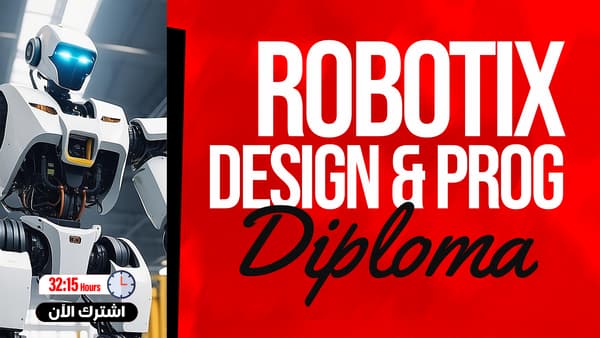
Robotics
Fundamentals of Robotics with Practical Applications
What you'll learn
- Understand the steps of building robots
- Learn the basic components of robots
- Learn the electronic and advanced components
- Understand the mechanical parts of a robot
- Understand the software components of a robot
- Write code to control the robot
- Control the direction and speed of the robot
- Build a robot from scratch
About this course
This course teaches the basics of robotics and robot building with hands-on practice. It starts with an introduction to the course, a first look at the world of robots and the steps of building a robot. Next you learn the basic components of robots and the electronic components, plus ways to control a robot in two directions, then advanced electronic components and mechanical parts, each in two parts. You then move to software components across three parts, the programming code and ways to control the speed of the robot. After that you carry out a project to build a robot from scratch in two parts, with an explanation of the code and robot control, and you download the workbook and the practical project code. The course suits people interested in electronics and programming, robot hobbyists and anyone who wants to start in this field. You need no previous experience, because the course begins with the first concepts. The explanation is practical, with a workbook and ready code to download, so you can try every part yourself. By the end, you will understand the parts of a robot, program it, control its direction and speed, and build a robot on your own.
Expected outcomes
- Comprehensive understanding of mechanical and electronic components of robots.
- Writing code to control robots.
- Implementing a project to build a robot from scratch.
- Practical application for robot control in different environments.
Learner reviews
- ★★★★★SHERIF B.·منذ 3 شهرشاهد 99٪
ماشاء الله شرح مبسط وجميل
- ★★★★★mostafaeltaher61·منذ 4 شهرشاهد 50٪
شرح مبسط .
- ★★★★★Maloook H.·منذ 5 شهرشاهد 70٪
- ★★★★☆زياد س.·منذ 5 شهرشاهد 100٪
ينقصه ان يكون الشرح بفيديو عملي وليس صور
تم عرض كل التقييمات (4)
Course content
1Robotics
18 lectures
- Course IntroductionIntroduces the robotics fundamentals course, covering designing, building and programming a robot, with topics including the importance of robotics, robot types, components, dynamics, control methods and applications.1:34
- Introduction to the World of RoboticsIntroduces the world of robots: the meaning of the word robot and its origin in a Czech play, stages of their development, fields of use such as manufacturing and healthcare, their classifications, and their effect on jobs and quality of life.9:29
- Steps to Build RobotsExplains the steps of building a robot, noting that its body determines its shape and function, its components, design factors of function, size, weight and cost, materials such as metal, plastic and carbon fiber, and the design stages.8:19
- Basic Components of RobotsExplains the robot's basic components, hardware with its electronic and mechanical parts plus software, the four electronic components, and details the power supply and the difference between DC and AC voltage.4:58
- Electronic Components for Building RobotsExplains three ways to control a motor in one direction, switches, a transistor and a relay, with each method's circuit and how it works, and the diode's role in protecting against reverse current.8:18
- Two-Way Control Methods for RobotsExplains controlling a motor in both directions in three ways: four switches, four transistors arranged in an H shape, and two relays, so the motor can turn forward or in reverse.10:25
- Advanced Electronic Components (Part 1)Explains the voltage regulator, a semiconductor component that gives a steady output whatever the input, how it works and how its pins are wired, positive and negative regulators, the heat sink, and its advantages.10:25
- Advanced Electronic Components (Part 2)Explains electronic sensors, which convert a physical quantity into an electrical signal, how they work, their four components, and types such as ultrasonic, proximity, temperature and pressure sensors.9:24
- Mechanical Parts (Part 1)Explains the electric motor that converts electrical energy to mechanical energy, its working principle through the interaction of electric and magnetic fields, its components, induction and permanent magnet types, and applications in appliances, cars and factories.5:29
- Mechanical Parts (Part 2)Explains wheels in a robot: how they work with the motor, their components, types such as front, rear, four-wheel and solar, classification by material, size, shape and application, and uses in transport, industry and agriculture.7:08
- Software Components (Part One)Explains the software side of a robot: the history of electronic controllers and integrated circuits (IC), the advantage of microcontrollers in changing function through programming, analog versus digital control, and the components of a control system.13:44
- Software Components (Part Two)Introduces Arduino as an open-source microcontroller whose design and code can be modified, compares board types such as Nano, Mega and Uno, and explains why Arduino Uno is the focus of the coming lessons.10:19
- Software Components (Part Three)Explains how to power an Arduino Uno board with the right voltage, then covers its power inputs and outputs, the digital and analog pins, and the voltage and current limits of each pin.11:33
- Programming CodesShows how to write a first sketch in Arduino IDE that turns an LED on pin 13 on and off, covering comments, brackets and semicolons, then checking the code with Verify and uploading it with Upload.19:28
- Ways to Control Robot SpeedExplains controlling a robot motor's speed with Arduino using values from 0 to 255, setting On Time and Off Time with delay in order to change the speed.15:25
- Building a Robot from Scratch (Part One)Starts building an Arm Robot with four servo motors and an Arduino Uno, explaining how servo wires connect to PWM pins, preparing the copper board, and mounting the first motor and gears.16:55
- Building a Robot from Scratch (Part Two)Continues building the robot arm by assembling the gripper that carries objects, then the remaining servo motors, plastic parts and frame, mounting the Arduino Uno and wiring it for the final form.7:09
- Explaining the Programming Code and Robot ControlWalks through the Arduino code that moves the robot arm: defining variables, including the Servo library, reading data from Serial, and using if and for loops to move each servo motor gradually.16:28
2Attachments
2 attachments
- Download the Workbook
- Download Codes and Practical Application Add-ons
Instructor

Eng. Iman Hajjo
This course is part of the diploma