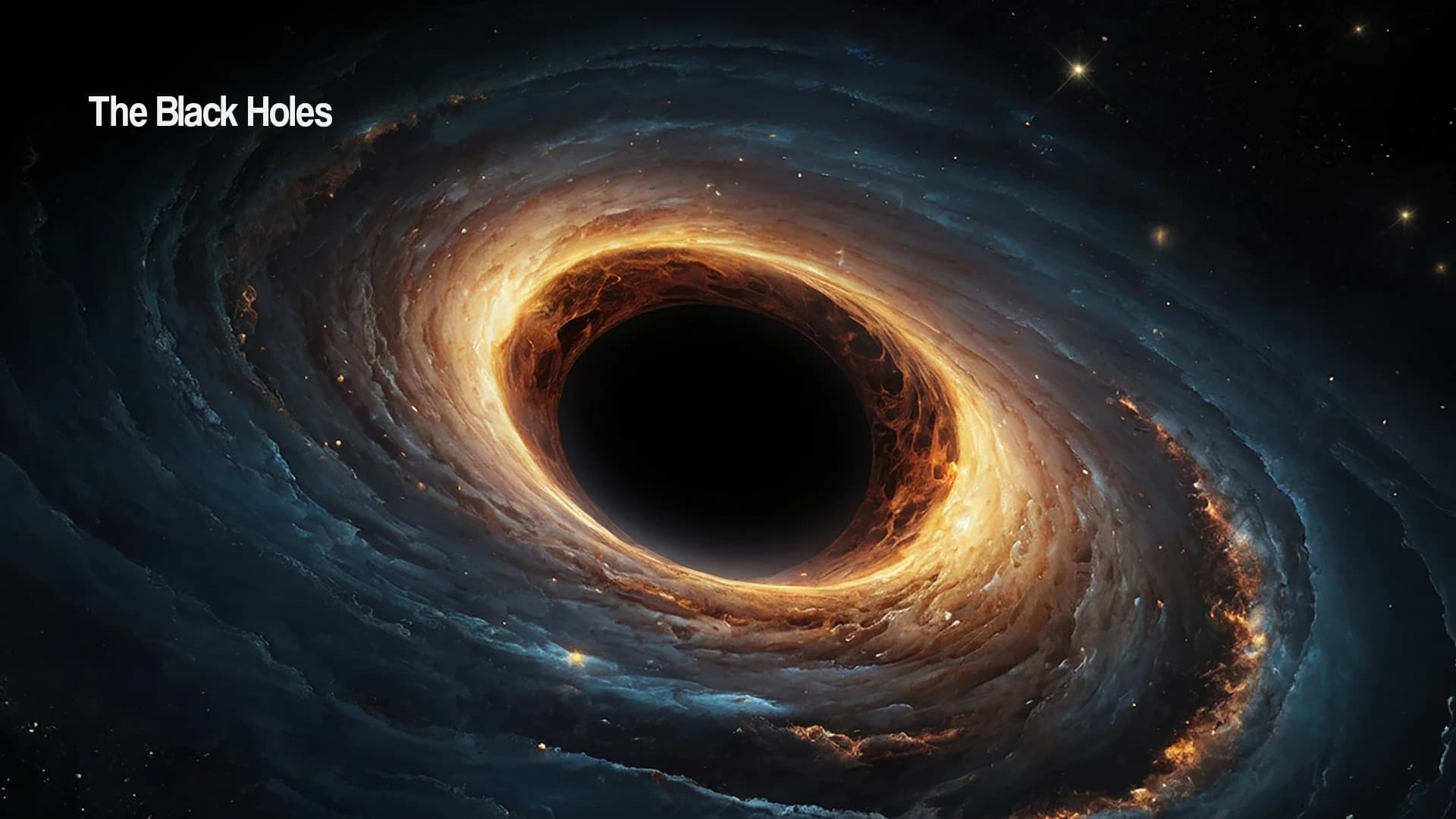
Black Holes
A visual journey through animation from Newton's apple to the first image of a black hole.
إعداد المادة العلمية : د/ معتز ابراهيم
هندسة صوتية : علي قنعان
انيميشن ورسوم : ايمان خليفة
إخراج فنى : م/محمد كريم
What you'll learn
- Understand gravity from Newton to Einstein
- Know escape velocity, the speed of light and the light year
- Follow the life of stars from birth to death
- Understand white dwarfs, neutron stars and supernovae
- Understand how a black hole is born and what the event horizon is
- Know about tidal forces and what happens when crossing the edge
- Know how scientists detected and imaged black holes
- Get to know gravitational waves and Hawking radiation
About this course
This course explains black holes with animation and in simple language, with no difficult equations, and it is part of a series that simplifies cosmic physics. It starts with Newton, gravity, escape velocity, the speed of light and the light year, then the idea of the dark star with Michell and Laplace, followed by Einstein and gravity as the shape of spacetime, and the solar eclipse. Then you follow the life and death of stars: white dwarfs and the Chandrasekhar limit, the supernova explosion and neutron stars, and the collapse of a star and the birth of a black hole. After that you go inside the black hole itself: Schwarzschild and the event horizon, the singularity, tidal forces, what a traveler sees when crossing the edge, and the rotating black hole. You also learn how scientists first detected a black hole, quasars, the telescope that imaged the black hole in a nearby galaxy, gravitational waves, then Hawking radiation and the information puzzle. The course suits anyone who loves space and science, from school and university students to adults, and it needs no background in physics or mathematics. By the end, you will be able to explain to others what a black hole is and understand space news and new discoveries.
Expected outcomes
- - Explain to others what a black hole is in simple words.
- - Understand space news and new discoveries about black holes.
- - Distinguish between a white dwarf, a neutron star, and a black hole.
- - Have a strong foundation to continue with the rest of the courses in the Cosmic Physics Simplification series.
Learner reviews
Course content
1البداية - الجاذبية والضوء
4 lectures
- نيوتن والجاذبية - التفاحة والقمر والمدفعExplains Newton's law of gravity: why the apple falls but the Moon does not, how the Moon and satellites orbit in constant free fall, how gravity weakens with the square of distance, and the difference between mass and weight.6:55
- سرعة الهروبExplains escape velocity, the minimum speed to leave a body's gravity without returning, what it depends on, why it differs for the Moon, Earth and Sun, and how it grows when the same mass is compressed.6:54
- سرعة الضوء والسنة الضوئيةExplains that light has a finite speed and how it was measured historically through delays in Jupiter's moon Io and Earth-based experiments, then defines the light-year as a distance unit for measuring how far stars are.6:39
- نجم ميشيل المظلم ولابلاسExplains the dark star idea of Michell and Laplace: a huge star whose escape velocity exceeds the speed of light and traps its light, how it could be detected through a star orbiting it, and why the idea faded once light proved to be a wave.6:39
2أينشتاين والزمكان
4 lectures
- الجاذبية شكل وليست قوةExplains how Einstein saw gravity as the shape of space and time rather than a force, from special relativity and the constancy of light speed to the equivalence principle and general relativity, where mass curves spacetime.6:56
- كسوف الشمس والساعات المختلفةPresents the evidence supporting general relativity: Mercury's orbit, starlight bending during a solar eclipse, time slowing near mass as shown by clock experiments, and the correction of GPS satellite clocks.6:38
- شفارتزشيلد وأفق الحدثExplains Schwarzschild's solution to Einstein's equations and the Schwarzschild radius, inside which compressed mass lets no light escape, and defines the event horizon as a boundary in spacetime rather than a solid wall.7:04
- المتفردة - حيث تسكت المعادلاتExplains how light cones tilt toward the center at the horizon, what the singularity is where the equations break down, how it differs from the horizon, and why scientists doubted the idea for so long until the name black hole settled.6:38
3حياة النجوم وموتها
6 lectures
- النجم ميزان يضبط نفسهExplains how a star stays balanced between gravity pulling inward and hot gas pressure pushing outward, how nuclear fusion in its core replaces lost energy, and how the star regulates itself like a self-adjusting balance.6:43
- الأقزام البيضاء وحد تشاندراسيخارExplains the fate of a Sun-like star after its fuel runs out: red giant, then white dwarf, held up by electron pressure under the Pauli principle, and the Chandrasekhar limit on the maximum mass it can support.6:57
- البصلة النارية والحديد الذي يطفئ النارExplains why massive stars die faster, the sequence of fuel burning in onion-like layers up to iron, whose fusion yields no energy, and the core's collapse once it reaches the Chandrasekhar limit.7:17
- انفجار السوبرنوفا والنجوم النيوترونيةExplains supernova explosions and their historical records, how they scatter the elements that planets and bodies are made of, and the neutron star left behind, its density, pulsars and why they spin so fast.7:14
- حين لا يبقى ما يقاوم - انهيار النجمExplains what happens to a dead core heavier than the neutron star limit: the three pressure supports fail and nothing stops the collapse, describing gravitational collapse, how it looks to a distant observer versus the infalling one, and the gravity that remains.6:53
- بنروز يغلق الباب، وكم ثقبا في مجرتناExplains Penrose's proof that a trapped surface makes collapse inevitable whatever the star's shape, the formation of stellar black holes, the ladder of stellar endpoints, the estimate of their number in our galaxy, and what would happen if the Sun became one.6:42
4داخل الثقب الأسود
4 lectures
- قوى المد - الفرق بين الرأس والقدمينExplains tidal forces, the difference in gravity between two ends of an object, how they account for ocean tides and Io's volcanoes, and why a small black hole tears apart anything approaching while a supermassive one lets it pass intact.6:45
- عبور الحافة - ماذا يرى المسافرExplains approach orbits around a non-rotating black hole: the last stable orbit, the photon sphere and the horizon, how the sky looks to the traveler, what they see and feel crossing the horizon, and how a distant observer sees it.6:35
- المتزلجة تضم ذراعيها - الثقب الدوارExplains why black holes spin, using the skater pulling in her arms and conservation of rotation, then the rotating Kerr black hole, frame dragging and the ergosphere outside the horizon where nothing can stay still.6:56
- طاقة من دوران الثقب، والثقوب لا شعر لهاExplains how energy can theoretically be extracted from a black hole's spin through the Penrose process, the effect of spin on horizon size and orbits, and the no-hair idea that a black hole is described only by mass, spin and charge.7:14
5كيف رصدنا الثقوب السوداء
6 lectures
- نجمان في رقصة واحدة وصوت سيارة الإسعافExplains how unlit black holes are found through their effect on a companion star, the Doppler effect and spectral line fingerprints to measure its motion and compute the hidden partner's mass, and the X-rays from infalling gas.7:22
- الدجاجة X-1 - أول ثقب أسود نجدهTells how the first black hole, Cygnus X-1, was found through a rapidly flickering X-ray source and a companion star, then other ways to find black holes such as jets, gravitational lensing and wobbling stars.7:17
- الكوازارات وما في قلب مجرتناExplains quasars as giant black holes fed by infalling matter that outshine a whole galaxy, how their distance and small size were established, then the supermassive black hole at our galaxy's center and how it was weighed from nearby stars' motion.7:09
- تلسكوب في حجم الأرض وصورة M87Explains how the shadow of a black hole was first imaged in galaxy M87 using an Earth-sized telescope of linked radio observatories, why the shadow looks larger than the horizon, the image of our own galaxy's hole, and how giant holes formed.6:54
- موجات الجاذبية - حجر في ماء ساكنExplains gravitational waves as ripples in spacetime traveling at light speed, why they are so faint, the indirect evidence from the binary pulsar, and how a laser interferometer with two perpendicular arms detects them.7:06
- 14 سبتمبر 2015 - أول مرة نسمع الكونTells the story of the first gravitational wave detected at the LIGO observatory from two merging black holes, how scientists confirmed it, what the lost mass converted to energy means, and later observatories and the neutron star collision.6:54
6إشعاع هوكينغ ولغز المعلومات
2 lectures
- إشعاع هوكينغ - الثقب الأسود يشعExplains Hawking radiation: how a black hole radiates and loses mass because of quantum particles near the horizon, the link between entropy and horizon area, the hole's temperature, and why the radiation has not yet been observed.6:41
- أين تذهب المعلومات، ومن التفاحة إلى الظلAddresses the fate of information falling into an evaporating black hole, the information paradox and Hawking's debate, primordial black holes and wormhole ideas, then recaps the course and the need for a theory uniting general relativity and quantum mechanics.6:35
Production team

إعداد المادة العلمية
Dr. Moataz Ibrahim
هندسة صوتية
علي قنعان
انيميشن ورسوم
ايمان خليفة
إخراج فنى
م/محمد كريم