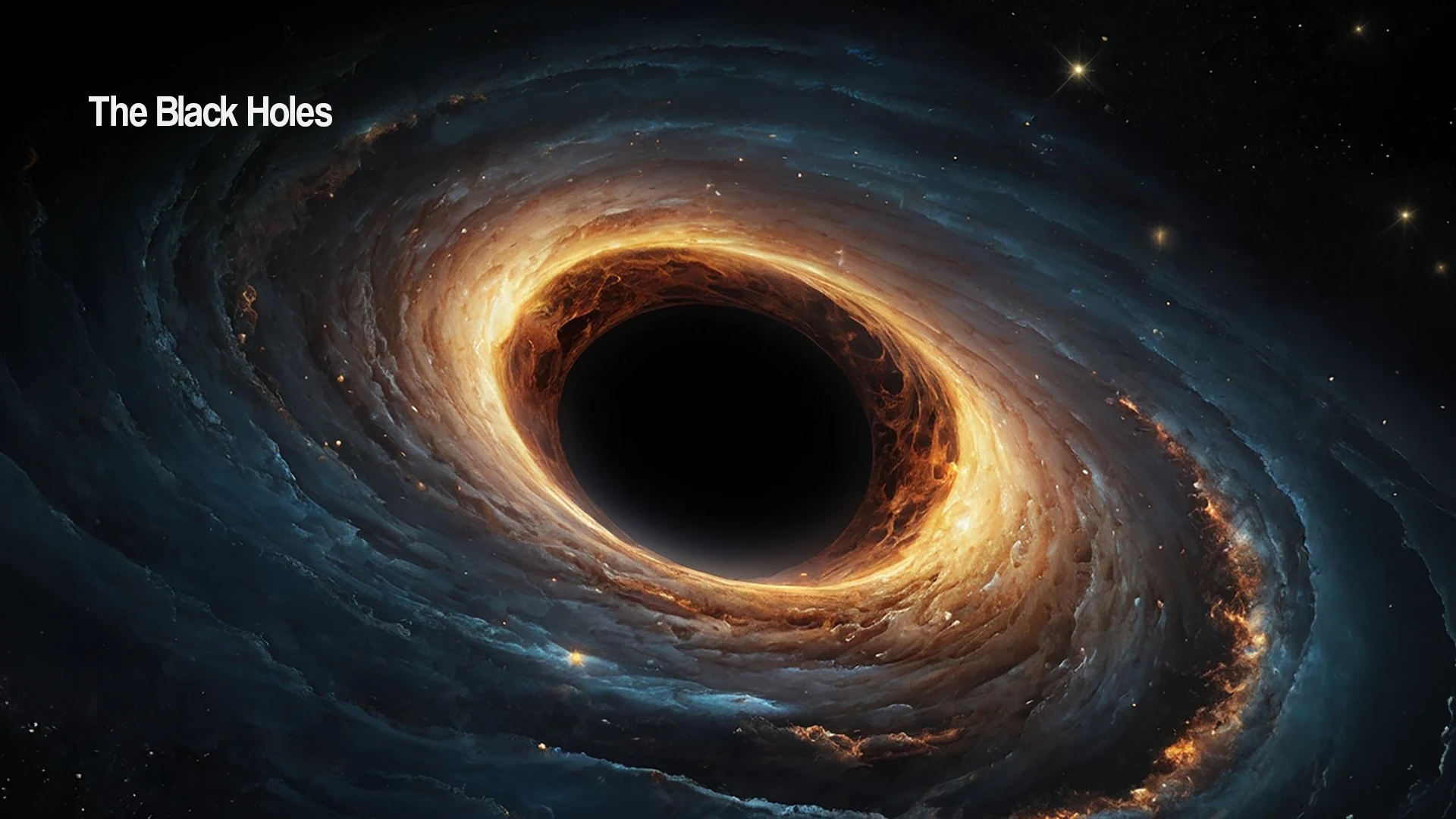

Black Holes
This course explains black holes with animation and in simple language, with no difficult equations, and it is part of a series that simplifies cosmic physics. It starts with Newton, gravity, escape velocity, the speed of light and the light year, then the idea of the dark star with Michell and Laplace, followed by Einstein and gravity as the shape of spacetime, and the solar eclipse. Then you follow the life and death of stars: white dwarfs and the Chandrasekhar limit, the supernova explosion and neutron stars, and the collapse of a star and the birth of a black hole. After that you go inside the black hole itself: Schwarzschild and the event horizon, the singularity, tidal forces, what a traveler sees when crossing the edge, and the rotating black hole. You also learn how scientists first detected a black hole, quasars, the telescope that imaged the black hole in a nearby galaxy, gravitational waves, then Hawking radiation and the information puzzle. The course suits anyone who loves space and science, from school and university students to adults, and it needs no background in physics or mathematics. By the end, you will be able to explain to others what a black hole is and understand space news and new discoveries.
- Explain to others what a black hole is in simple words.
- Understand space news and new discoveries about black holes.
- Distinguish between a white dwarf, a neutron star, and a black hole.
- Have a strong foundation to continue with the rest of the courses in the Cosmic Physics Simplification series.
- Understand gravity from Newton to Einstein
- Know escape velocity, the speed of light and the light year
- Follow the life of stars from birth to death
- Understand white dwarfs, neutron stars and supernovae
- Understand how a black hole is born and what the event horizon is
- Know about tidal forces and what happens when crossing the edge